
E-scooter accidents 2025: What ADAC and Destatis really show
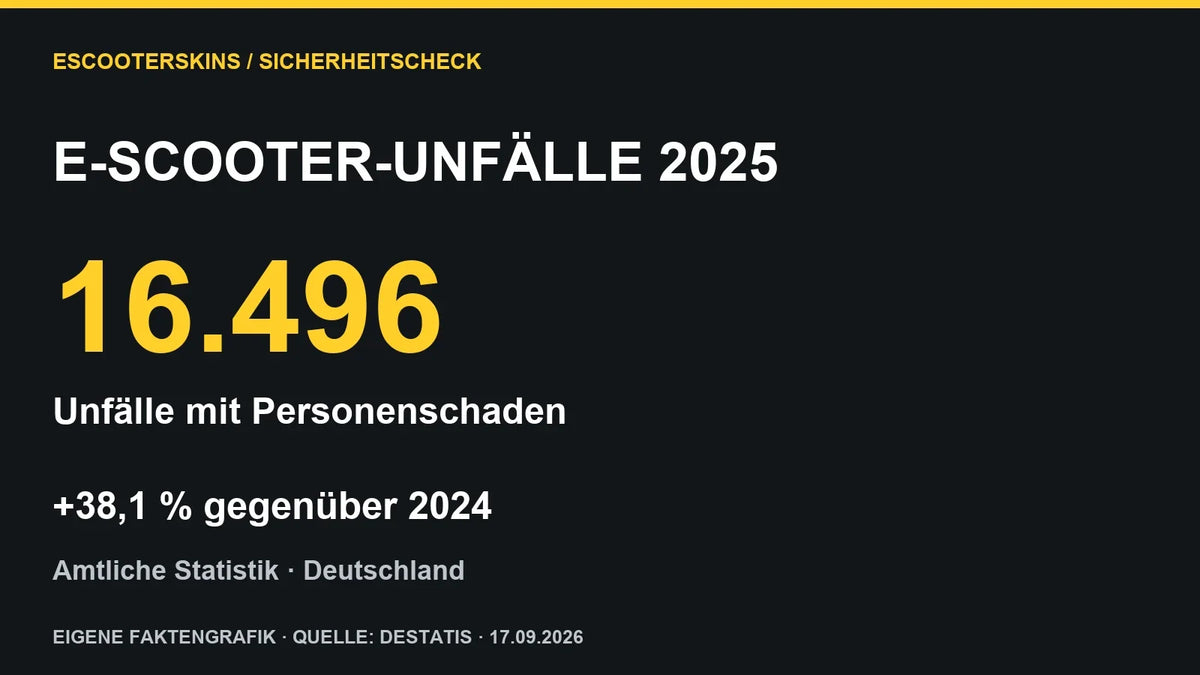
Destatis recorded 16,496 accidents involving e-scooters that resulted in personal injury in 2025. This was 38.1 percent more than in 2024. A current ADAC analysis puts the official figures into context alongside findings from trauma surgery. It is crucial not to mix up the various data sets: the 16,496 figure refers to accident events, not the number of injured riders.
What the official statistics for 2025 show
According to the Destatis evaluation of July 16, 2026, 38 people died in accidents involving e-scooters. 33 of them were riding an e-scooter. In total, 1,895 people were seriously injured and 16,184 were slightly injured in these accidents. Both of these figures include all road users involved, not just scooter riders.
14,936 of the casualties were riding an e-scooter themselves. Among them were 822 passengers, even though carrying passengers on e-scooters is not permitted. 53.6 percent of the injured scooter riders were younger than 25 years old. Almost a third of the recorded accidents, 30.5 percent, were single-vehicle accidents.
The statistics focus heavily on urban traffic: 49.1 percent of accidents occurred in cities with at least 100,000 inhabitants. This is a geographical distribution of registered cases, not a personal risk forecast. To make such an assessment, the number of accidents would need to be put in relation to the respective mileage, type of route, and intensity of use.
The most frequent types of misconduct
In accidents involving personal injury, the most frequently attributed misconduct to riders was the improper use of the road or sidewalk: this accounted for 21.6 percent of recorded misconduct. Alcohol followed with 10.9 percent, and inappropriate speed with 8.4 percent. These are shares of the misconduct determined by the police and do not indicate how often an individual rider generally causes an accident.
For everyday use, this results in a clear sequence of rules: stay on bike lanes or authorized traffic areas, ride alone, adapt your speed to the situation, and refrain from using the scooter after consuming alcohol. While a helmet is not mandatory in Germany, it can be sensible, especially given the frequent head and facial injuries. You can find further practical examples in our article on e-scooter rider training; we explain the applicable fundamentals in our e-scooter buying guide.
What the clinical data adds
In its analysis dated September 10, 2026, the ADAC refers to a study from the TraumaRegister DGU. The study published in the Deutsches Ärzteblatt examined 538 seriously injured e-scooter riders from the years 2020 to 2023. 78.4 percent were men, and the average age was 44.3 years. Alcohol was documented in 34.9 percent of cases, and 54 percent of the accidents occurred at night. 83 percent had severe injuries to the head or face; 26 patients died.
This clinical sample describes particularly severe cases and cannot be extrapolated to all trips or all e-scooter accidents. The authors also point to a lack of exposure data: without reliably comparable mileage or trip numbers, no accident risk per distance can be derived from the absolute case numbers. Differences compared to the use of other modes of transport are also only comparable to a limited extent.
Furthermore, the TraumaRegister only covers clinics and patients that meet its inclusion criteria. The study is therefore particularly valuable for identifying injury patterns among the severely injured, but it does not answer what proportion of all scooter accidents leads to such injuries. Official accident statistics and clinical registers complement each other, but they measure different things.
Our assessment
The increase in reported accident figures is a serious safety signal. However, it does not prove on its own that every single ride has become more dangerous. For that, it would be necessary to know how much the stock of e-scooters and the total mileage have increased over the same period. The concrete patterns are reliable: young riders are heavily represented, single-vehicle accidents make up a large share, and alcohol and the improper use of traffic areas repeatedly play a role.
Note on this article: Source check as of September 17, 2026. The basis is published accident statistics and studies; no individual accident risk or comparison per kilometer driven can be derived from this.