
E-scooter safety training: EU platform presents Austrian school project
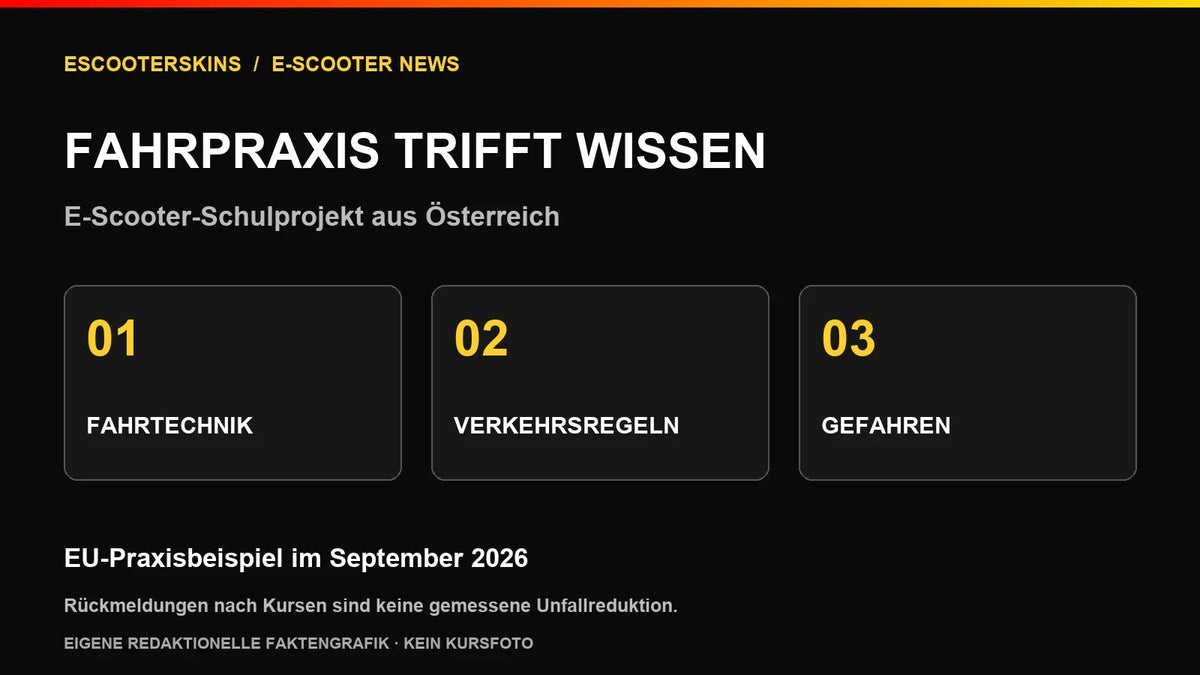
The European Road Safety Charter has presented the e-scooter training project by Madlencnik Mobility as its good practice example for the month of September 2026. The publication is dated September 2nd in the platform's news directory. The occasion is therefore the current recognition of an existing project, not the launch of a new course.
Editorial staff EscooterSkins · Sources verified on September 9, 2026 · Report based on internal assessment, no personal participation in the course.
Key points of the project
- Two-hour practical school courses in Upper Austria.
- Combination of vehicle control, traffic rules, and hazard perception.
- According to the project presentation, around 1,000 students reached and more than 30 trained instructors.
- The published success metrics are based, among other things, on post-course feedback; they do not represent a measured reduction in accidents.
How the program is structured
The September presentation by the European Road Safety Charter describes a program that combines practical exercises, digital learning content, and the training of further instructors. A multilingual learning app complements the in-person courses. The project period documented there ranges from March 2022 to December 2025.
In the detailed project description provided by the vendor, it is explained that the State of Upper Austria funds the school courses and provides scooters and helmets. Mobile teams handle the implementation on-site. The vendor identifies the distribution of equipment and sufficient qualified personnel as organizational challenges.
For schools, this is a concrete approach: participation does not depend solely on whether families own their own vehicle. However, the source describes the Austrian project; no currently bookable or free offer for German schools can be derived from this.
What the numbers say – and what remains unanswered
The vendor reports that 92 percent of the surveyed students stated they felt safer after the course. 88 percent reported having learned new traffic rules and riding techniques. The basis for this, they state, is standardized feedback forms collected immediately after the courses, as well as further qualitative feedback.
Such responses show how participants perceive the training. In themselves, they do not prove permanently better riding behavior or a specific reduction in accidents. For such a conclusion, a comprehensible before-and-after comparison, a suitable control group, and long-term observation would be necessary, for example. The published project pages do not present such accident comparison data.
Our assessment: Proximity to practice and positive feedback make the concept interesting. A promised percentage gain in safety cannot be calculated from this. The presentation on the EU platform also does not replace an independent effectiveness study.
What riders in Germany can take away
The fact that vehicle control should be practiced is also emphasized by the ADAC in its riding tips. It covers braking and hand signals in particular, and recommends suitable practice areas as well as protective equipment. This guide dates from May 15, 2024, and serves here as professional background, not as a new report.
Anyone selecting a training course should ask about supervised exercises with their specific scooter type, sufficient space, and feedback on riding technique. Furthermore, the content should align with German traffic rules. A foreign course or a translated app is no guarantee that all local regulations are covered.
When switching models, a detailed introduction to operation is also helpful. Our e-scooter buying guide offers orientation for model selection; practical practice and instruction on the specific vehicle remain separate steps.
Sources and status
- European Road Safety Charter: Good Practice Example September 2026.
- Madlencnik Mobility: Project description and evaluation, on the Charter platform.
- ADAC: Riding e-scooters – braking and turning correctly, May 15, 2024.
Verified on September 9, 2026. No cooperation, personal course participation, or measured impact on accidents is claimed.